The delivery problem in neurology
The blood–brain barrier (BBB) keeps most intravenous drugs — and most cells — out of the brain. Intravenous cell infusions are largely trapped in the lungs, liver and spleen; only a small fraction reaches the CNS. Direct injection into the brain or cerebrospinal fluid works but is invasive, carries surgical risk, and is hard to repeat — especially in a newborn weighing three kilograms.
How the intranasal route works
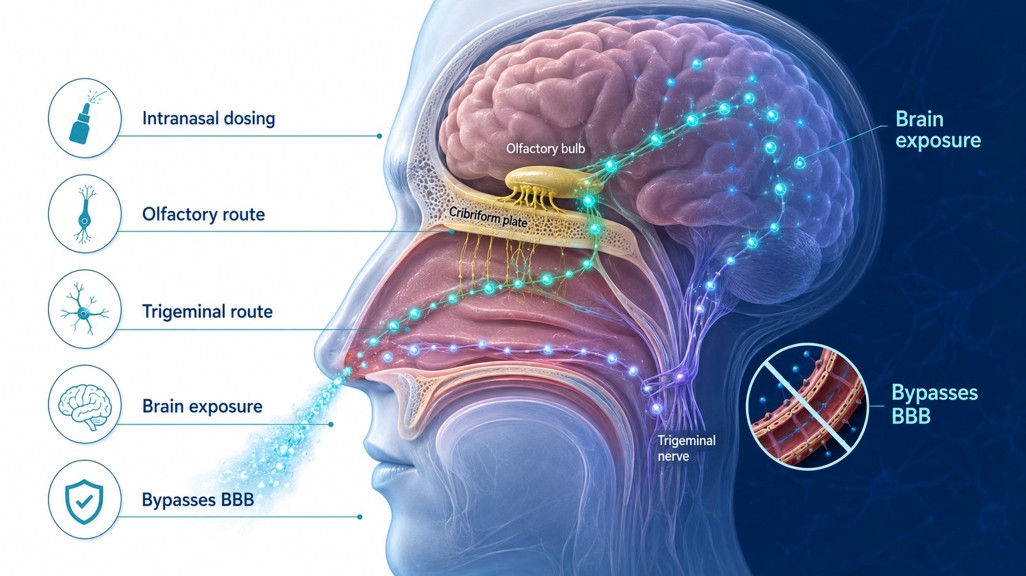
The nasal cavity is the one place where the central nervous system meets the outside world. Cells applied to the upper nasal cavity migrate along the olfactory nerve through the cribriform plate into the olfactory bulb and forebrain, and along branches of the trigeminal nerve toward the brainstem. From there they distribute along perivascular spaces to injured regions, guided by inflammatory chemokine signals.2,3
Cells home preferentially to sites of injury rather than distributing uniformly.
Why it matters for newborns
Fragile, cooled newborns in intensive care cannot tolerate neurosurgery. Intranasal administration takes minutes at the bedside with a standard atomiser, needs no anaesthesia, and can be repeated. It also extends the therapeutic window: Can‑Vas 001 is designed as an add-on to cooling within 24 hours of birth, rather than the six-hour limit of cooling itself.
Clinical precedent
The PASSIoN trial at UMC Utrecht delivered a single intranasal dose of mesenchymal stromal cells to ten newborns with perinatal arterial ischaemic stroke. There were no adverse events attributable to the therapy at two-year follow-up.1 Intranasal cell delivery has also been studied in adults with stroke and Parkinson's disease.
Peak 15 Bio's approach
Can‑Vas 001 combines placental endothelial colony-forming cells with MSCs in a cryopreserved, off-the-shelf product thawed at the point of care and given intranasally. Follow-on adult programmes will use intranasal or intravenous routes as the indication requires. See the HIE unmet need for the clinical context.
Frequently asked questions
Do cells really reach the brain through the nose?
Yes. Rodent, large-animal and primate studies show labelled cells in the olfactory bulb, cortex, hippocampus and brainstem within hours of intranasal administration, with preferential homing to injured tissue.
Is intranasal cell therapy safe?
Early human studies, including in newborns, have reported no therapy-related adverse events. Safety and tolerability remain the primary endpoints of first-in-human studies.
Can the dose be repeated?
Yes — that is one of the route's main advantages over surgical delivery.
- Baak LM et al. PASSIoN: intranasal MSCs after perinatal arterial ischaemic stroke. Lancet Neurology 2022; two-year follow-up, Stroke 2025.
- Danielyan L et al. Intranasal delivery of cells to the brain. European Journal of Cell Biology 2009.
- Lochhead JJ & Thorne RG. Intranasal delivery of biologics to the central nervous system. Advanced Drug Delivery Reviews 2012.
Can‑Vas products are investigational and have not been approved by any regulatory authority. This page is for general information and is not medical advice.